
Hopkins County Criminal Court Cases
Hopkins County criminal court cases do not all go to one clerk. Felonies are heard in the district courts serving the county, chiefly the 8th and 62nd Judicial Districts. The Hopkins County District Clerk keeps those felony files at 282 Rosemont Street, Suite 2, in Sulphur Springs. The main line is (903) 438-4081. Criminal deputy lines are (903) 438-4086 and (903) 438-4084. Published counter hours are Monday through Thursday, 8:00 a.m. to 5:00 p.m., with a noon closure, and Friday, 8:00 a.m. to 4:00 p.m., open through noon.
Class A and B misdemeanor records generally run through the Hopkins County Court at Law and County Clerk. Fine-only cases remain with a justice court or the municipal court that received the city charge. That split matters. A clean felony-clerk result does not rule out a county misdemeanor, a Class C ticket, or a city ordinance file. Ask for the cause number, court, filed charge, and final disposition rather than a broad name-only answer.
The manifest captures the District Clerk contact and hours page used for felony record requests.
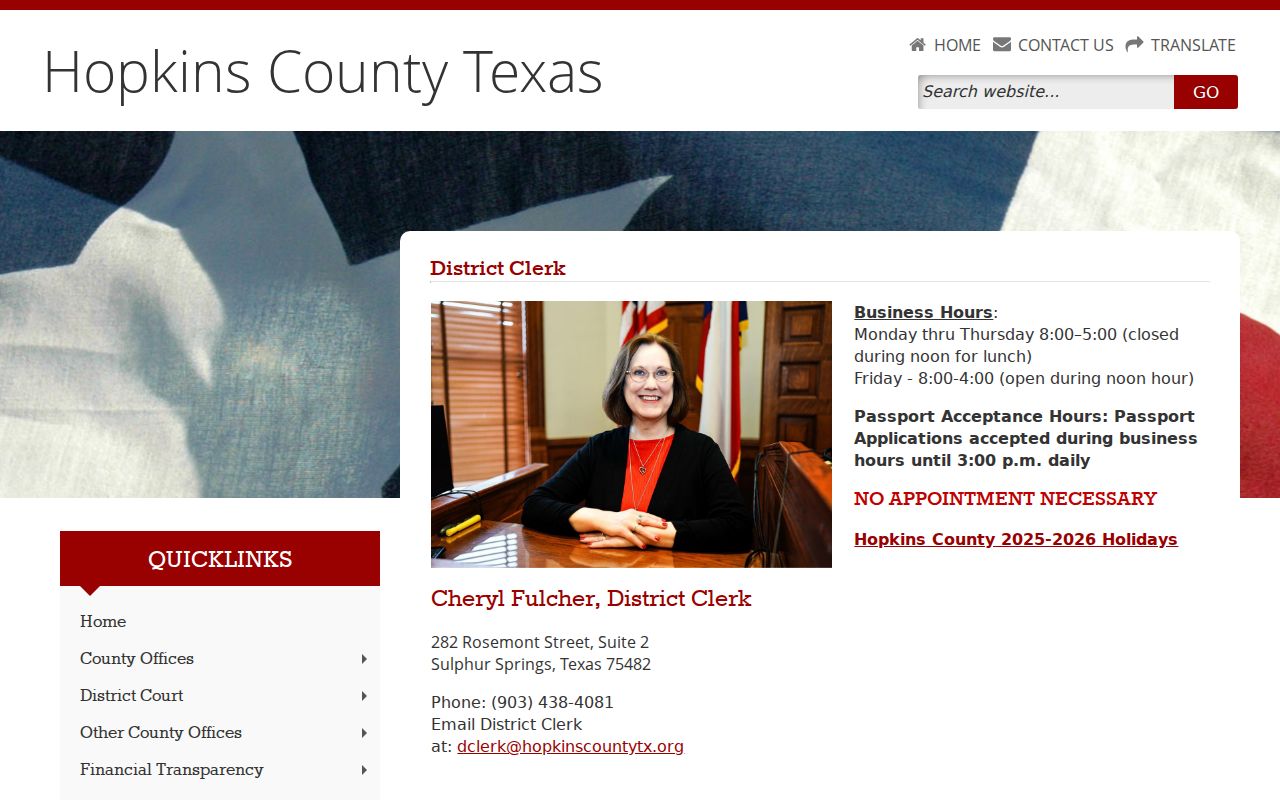
That official page is the best starting point when a Hopkins County case belongs to a district court or an older felony file is not online.
Hopkins County Felony and Misdemeanor Courts
The 8th Judicial District courtroom is listed at 298 Rosemont, with its office at (903) 438-4022. The 62nd Judicial District also serves Hopkins County, while its judge's office is listed at (903) 737-2434. The District Clerk remains the file custodian for district matters. A returned indictment, motions, settings, plea papers, judgment, sentence, and appeal notices can become part of that clerk file.
The Hopkins County Court at Law sits at 118 Church Street and can be reached at (903) 438-4004. It hears criminal misdemeanors and Class C appeals, but its official page expressly excludes felony jury trials. The County Clerk at 128 Jefferson Street, Suite C, can be reached at (903) 438-4074 for county misdemeanor records and certified copies. Both clerks may maintain records tied to the court, so state the case level when calling.
The county's court page is shown in the assigned County Court at Law source image.
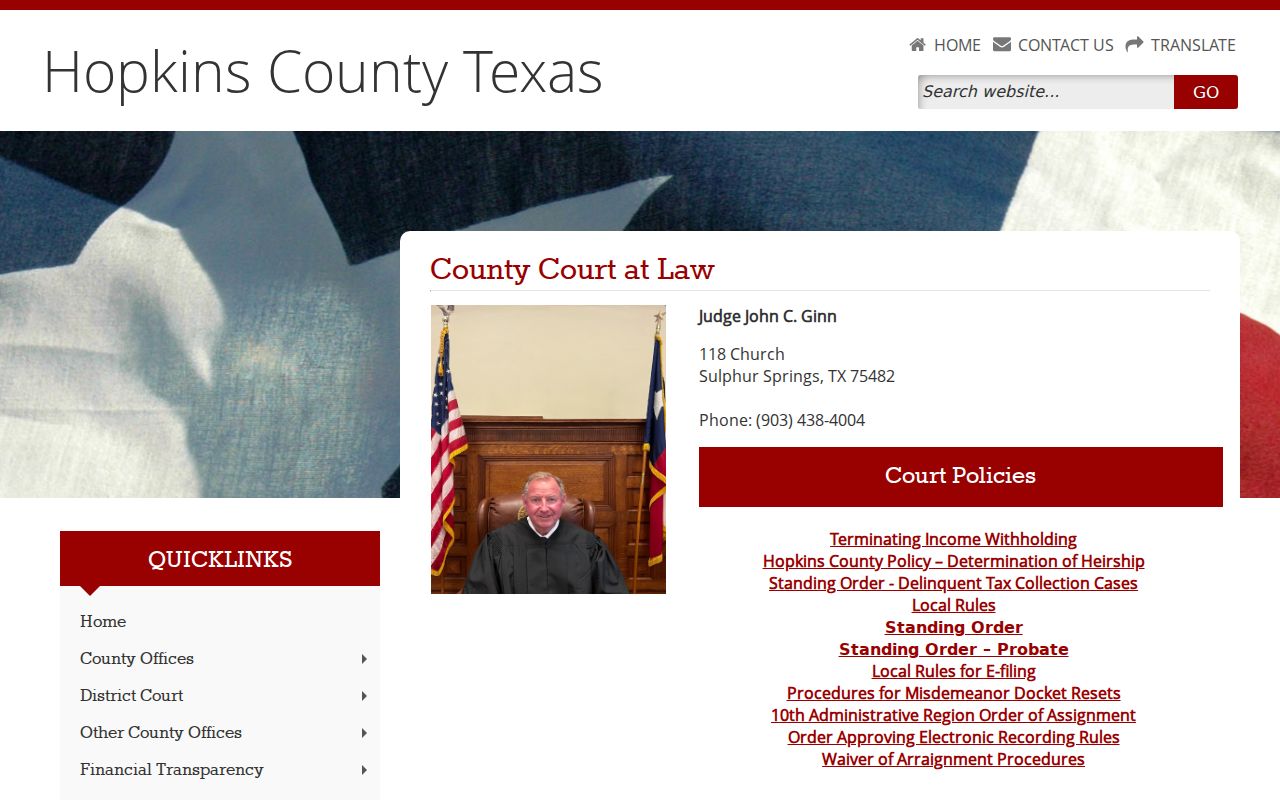
Its stated jurisdiction helps prevent a felony search from being sent to the misdemeanor court, or a misdemeanor request from being sent only to the District Clerk.
Searching Hopkins County Case Records
Hopkins County chiefly publishes docket PDFs and lists of cases set by a court, not a free countywide party-name index. A docket is useful for an upcoming setting, but it is not the full case file. Start with the offense level and issuing court. Use a full name, date of birth, cause number, and likely filing year when known. Then ask the correct clerk to verify whether the case is pending, disposed, archived, or held by a lower court.
- Check the county's published criminal docket or cases-set links for the court likely to hold the matter.
- Call the District Clerk for felonies or the County Clerk and County Court at Law for Class A and B misdemeanors.
- Contact JP Precinct 1, JP Precinct 2, or the issuing municipal court separately for fine-only and city cases.
- Use re:SearchTX as a supplement, narrowing the court, case type, date, and party fields.
- Request an inspection copy, charging instrument, docket, and judgment from the custodian; ask about certification and current cost before ordering.
| Field Label | Type | Required | Notes |
|---|---|---|---|
| Person or organization | Text | Search-dependent | Use the exact name and known variants. |
| Case number | Text | Alternative | The strongest direct identifier when known. |
| Court or location | Filter | No | Narrow to Hopkins County or a serving district court. |
| Case type | Filter | No | Select criminal where the portal offers it. |
| Date range | Date filter | No | Use the likely filing or event span. |
A portal result may identify the court and cause, but the Hopkins County clerk can confirm the latest docket status and quote the cost of the exact copy needed.
re:SearchTX and Hopkins County Gaps
re:SearchTX is the named statewide court-record platform, but court participation, indexed coverage, document access, and charges can vary. Registration may be required. A missing result is not proof that no Hopkins County criminal court case exists. County docket PDFs may show settings that the statewide system does not expose in the same way, while a clerk may hold documents that neither online view displays.
The assigned statewide court portal image shows the search entry point rather than any person's record.
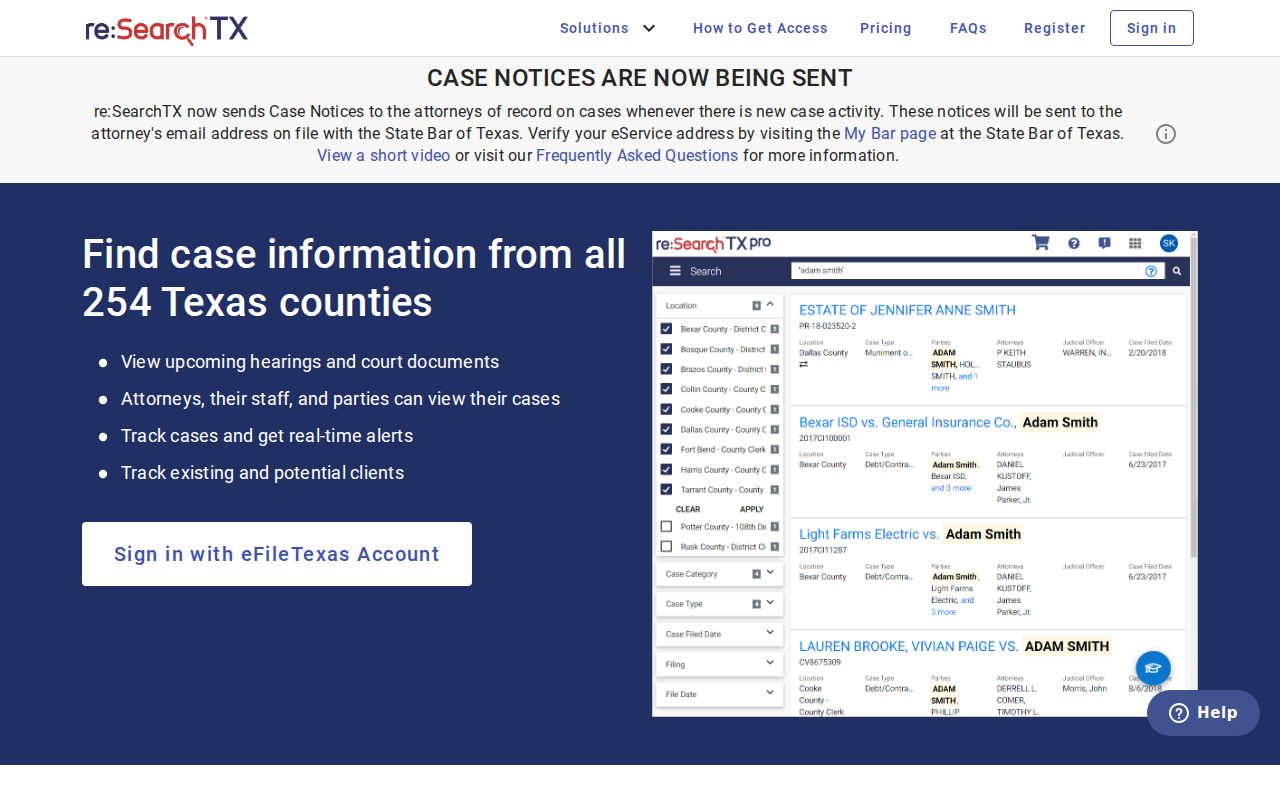
Use an online hit to identify the cause and court. Use the originating Hopkins County clerk for a complete inspection or certified judgment. If no result appears, try name variants, widen the date range, and call the clerk before drawing a conclusion.
Note: A statewide index is a lead to a Hopkins County file, not a substitute for the clerk's signed judgment.
Inside a Hopkins County Case File
A Hopkins County court file is organized by cause number and docket, not by the jail booking number. The charging instrument shows what the State pursued after review. That charge may differ from the arrest allegation. Docket entries track filings and settings, while a signed judgment states the formal outcome. Ask for both the charging instrument and judgment when the goal is to understand what happened, rather than relying on one brief docket line.
| Cause Number and Court | Identifies the file and the Hopkins County court with jurisdiction. |
|---|---|
| Charging Instrument | The complaint, information, or indictment stating the filed allegation. |
| Docket Entries | A dated list of settings, motions, filings, pleas, and court acts. |
| Hearing Dates | Past and future settings, which do not by themselves show a final result. |
| Disposition and Judgment | The dismissal, acquittal, conviction, deferred result, or other court outcome. |
| Sentence and Conditions | Jail or prison term, fine, costs, restitution, or community-supervision terms. |
Financial entries can include bond, fines, court costs, or restitution. Sentence entries may state jail or prison time, community supervision, and whether terms run together or one after another.
Hopkins County Class C Case Trails
Class C cases can be easy to miss because they do not belong in the district felony file. Hopkins County JP Precinct 1, at 128 K Jefferson Street, uses (903) 438-4026. JP Precinct 2, at 128 G Jefferson Street, uses (903) 438-4036. Sulphur Springs, Cumby, and any other operating municipal court keeps its own city-issued ticket or ordinance files. A Class C appeal may later reach the County Court at Law.
The county's official ticket and deferred-disposition page is preserved in the assigned image.
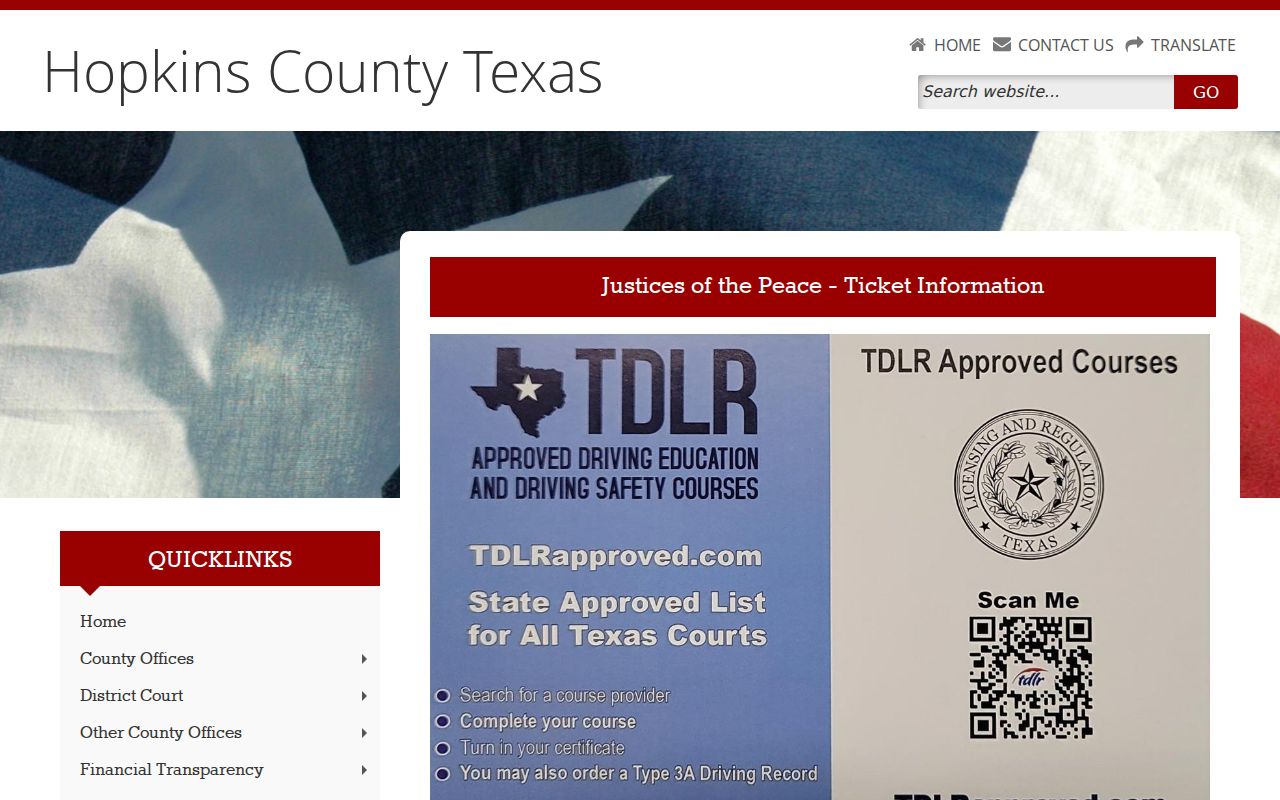
That resource explains local ticket rights and deferred-disposition options, including a period of up to 180 days and stated limits for specified work-zone or commercial-driver matters. The ticket page is not a party-name court index. Contact the issuing JP or city court for the actual file and its result.
How a Criminal Case Moves
An arrest begins an agency and booking trail, but the prosecutor decides what charge to file. A felony may go through grand-jury review and indictment. A misdemeanor commonly begins with a complaint or information. Arraignment presents the charge and takes a plea. Pretrial settings and motions follow. The case may then end by dismissal, plea, trial, or another lawful disposition, with sentencing after a conviction.
Case flow: Charges Filed › Arraignment › Pretrial › Plea or Trial › Disposition › Sentencing
The stages are not fixed to a single Hopkins County timetable in the official material. A setting is only a scheduled event. It does not prove the hearing occurred or that the case ended. Confirm each step against the current docket and signed orders.
Hopkins County Dispositions in Plain Terms
A docket entry needs context. A no-bill means the grand jury did not return an indictment on the charge presented. Dismissed means the filed count ended without a conviction on that count. Deferred adjudication postpones a finding while the person completes court-ordered community supervision; it is not an acquittal or an expunction. Convicted means a judgment of guilt. These terms describe very different outcomes.
- Pending
- The Hopkins County case remains open or awaits a court act.
- Dismissed
- The filed count ended without a conviction on that count.
- No-bill
- The grand jury declined to indict the charge presented.
- Deferred adjudication
- A court defers a guilt finding during community supervision.
- Convicted
- The court entered a judgment of guilt.
When a docket has no disposition, ask the clerk for the latest signed order or judgment. A Hopkins County arrest entry or DPS result can lag behind the clerk's source file. The clerk's certified judgment is the sound record for proving the court result.
Older Hopkins County Case Records
Older Hopkins County files may not be indexed online. Give the clerk a full name, date of birth, likely year, charge type, and any prior cause number. Ask whether the record is archived and whether electronic inspection, a plain copy, or a certified judgment is available. Published plain and certified criminal-copy rates were not located in the research, so request a current quote before ordering.
The District Clerk fee page is shown in the manifest image below.
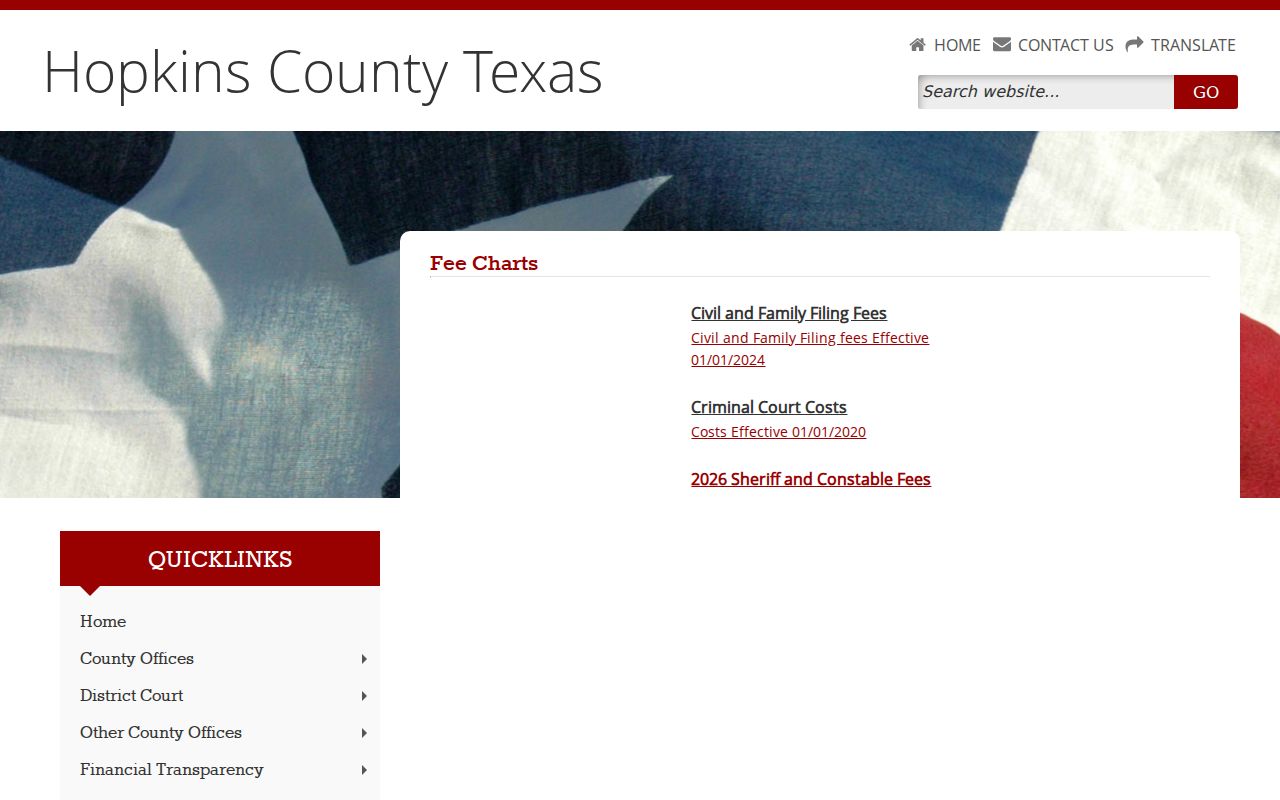
It is a fee-chart landing page, not proof of a current criminal-copy price. Confirm the record type, page count, certification need, delivery format, and total with the clerk. An arrest-only trail is addressed through the Hopkins County arrest lookup channels.
Case Record Access & Restrictions
Court records are judicial records and do not always follow the same process as executive-branch requests under the Texas Public Information Act. Request a Hopkins County court file from the clerk who exercises jurisdiction. Public copies may omit Social Security numbers, financial-account data, protected victim details, medical data, and certain juvenile information. Expunged and nondisclosed material may also be absent from public access under its controlling order and statute.
Texas Government Code Chapter 552 governs requests to local agencies, while Government Code Chapter 411 controls criminal-history dissemination and nondisclosure. Code of Criminal Procedure Chapter 66 governs reporting from courts and agencies to DPS. A sealed or missing online result should be discussed with the proper clerk, not treated as proof that no record ever existed.